When a Cozy Pokémon Game Leads Players Into a Competitive Wall
A Franchise That Tries to Be Everything at Once

Written by
Carter Gaming Lab
Articles
May 19, 2026
4 min read
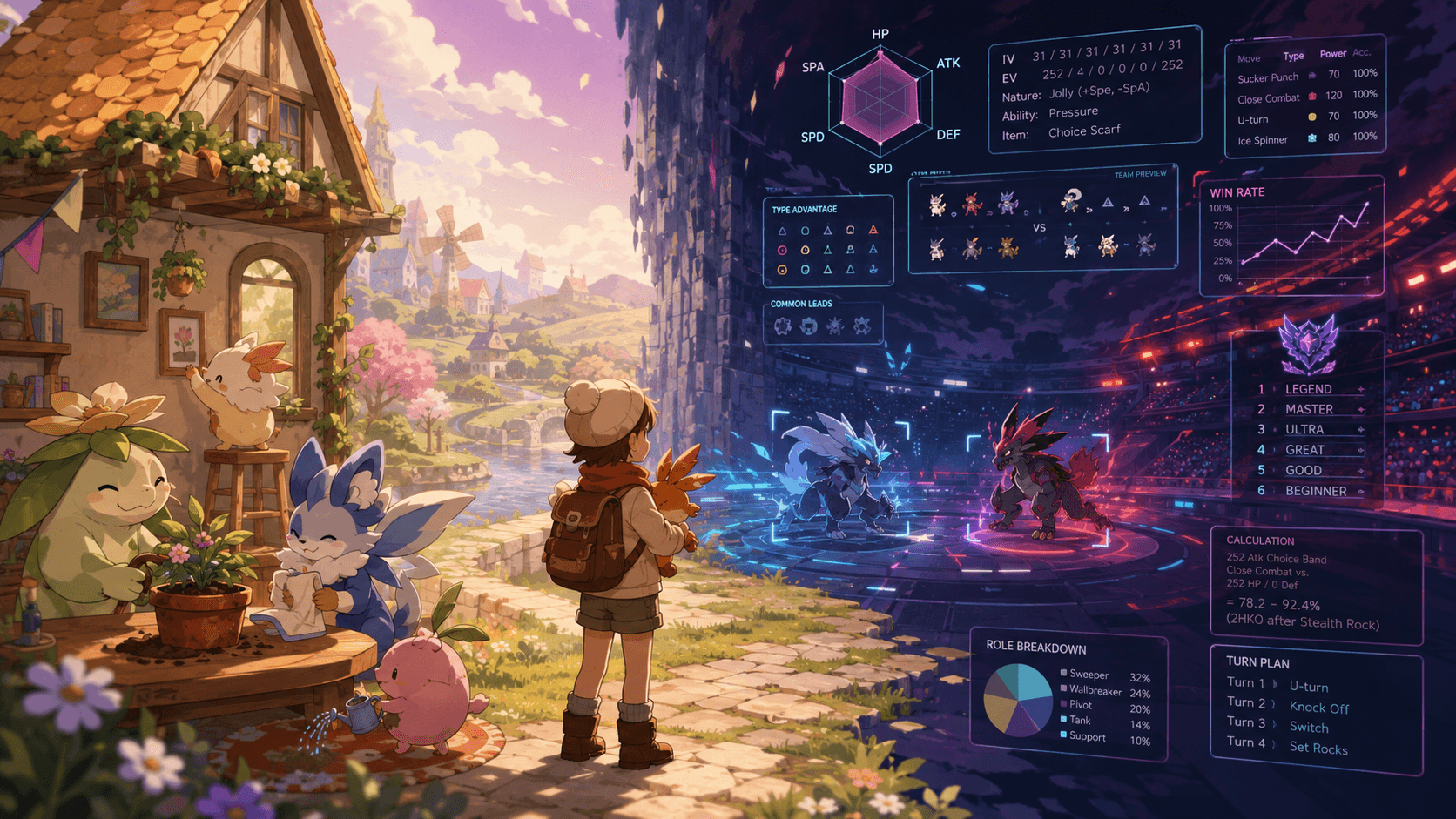
Pokémon has always existed in a strange space between simplicity and complexity. On the surface, it presents itself as one of the most approachable RPGs ever created: explore the world, collect creatures, battle your way forward. But beneath that simplicity lies one of the deepest mechanical systems in mainstream gaming, shaped by decades of iteration and a competitive scene that continues to evolve long after each release.
For experienced players, this depth is part of the appeal. Understanding team composition, predicting opponent behavior, managing risk, and optimizing small statistical advantages creates a form of strategy that rewards long-term engagement. For newer players, however, the same depth can feel like a barrier. The expectation that one should understand typing matchups, abilities, move pools, and hidden stat mechanics can make Pokémon appear more intimidating than its colorful presentation suggests.
Pokopia represents one of the clearest attempts yet to address this gap. Rather than introducing players to Pokémon through mechanics, it introduces them through atmosphere. The tone is softer, the pacing slower, and the focus shifts from optimization to interaction. The comparison to Animal Crossing is difficult to ignore. Progress is not defined by winning battles, but by spending time in the world, customizing spaces, and forming emotional attachments to Pokémon.
By removing pressure from the earliest stages of play, Pokopia lowers the psychological hurdle of picking up a Pokémon game. Players are not required to understand systems before they can begin enjoying the experience. Instead, enjoyment itself becomes the entry point.
This approach does more than simply broaden accessibility. It changes the type of player who may consider entering the Pokémon ecosystem in the first place.
When Emotional Connection Leads to Curiosity
One of the strongest effects of lifestyle-oriented game design is that attachment often precedes mastery. Players who begin by casually interacting with Pokémon often become curious about what else those Pokémon are capable of doing. Emotional investment creates a natural desire to explore further systems.
Once players care about their Pokémon, battling becomes more interesting. Strategy becomes more meaningful. Improvement becomes more motivating.
This is where Pokémon Champions appears positioned to take over.
Champions provides a structured environment focused on the strategic core of Pokémon battles. Instead of progressing through a traditional RPG to eventually reach competitive play, players can engage directly with the systems that define mastery. Team building, matchup prediction, adaptation, and optimization become the primary focus.
On paper, the relationship between Pokopia and Champions is logical. One lowers the barrier to entry. The other provides depth for players who wish to explore further.
Together, they create a potential pathway from curiosity to expertise.
However, recent player discussions suggest that the transition between these experiences may not feel entirely seamless.
The Mega Floette Conversation
One topic appearing repeatedly across X and Reddit discussions surrounding Pokémon Champions involves Mega Floette. According to player reports, Mega Floette is not obtainable within Champions itself, but instead requires ownership of Pokémon Legends Z-A, along with progression deep into its endgame challenge content. Players describe needing to complete extended wave-based encounters before gaining access.
Whether Mega Floette ultimately proves dominant in the competitive meta is almost secondary to the reaction it has generated. The discussion is less about a single Pokémon and more about what the situation represents.
Champions is positioned as a competitive-focused platform. In competitive environments, players generally expect that strategic options are accessible within the environment itself. When certain options appear tied to ownership of another title, the competitive experience can begin to feel partially dependent on progression outside the platform.
For long-time players, this structure may feel familiar. Pokémon has historically encouraged connectivity between titles. Transferring Pokémon across games has always been part of the franchise identity.
For newer players entering through Pokopia, however, the situation can feel different.
Their first experience communicates that Pokémon is welcoming, flexible, and easy to begin. Champions may then introduce a reminder that the ecosystem still contains layers shaped by decades of interconnected design decisions.
The Tension Between Accessibility and Continuity
Pokopia lowers the hurdle of picking up a Pokémon game by reducing mechanical pressure and emphasizing emotional connection. Players are allowed to engage at their own pace without needing to immediately understand optimization systems. This expands the range of players who feel comfortable entering the franchise.
Champions, by contrast, highlights the strategic depth that has always existed beneath the surface of Pokémon battles. The complexity is not new, but its visibility increases once players attempt to engage competitively.
When access to certain competitive options appears linked to prior engagement with other titles, the experience can feel uneven for players who began their journey through a more accessible entry point.
Instead of focusing purely on improving their understanding of battle mechanics, players may find themselves evaluating whether they need additional experience outside the competitive platform itself.
This creates a subtle but noticeable shift in perception.
Improvement no longer feels entirely contained within the competitive environment.
Participation begins to feel influenced by external progression.
Even if the practical gameplay impact is limited, perception plays an important role in how welcoming a competitive system feels.
Why Competitive Communities Notice Small Details
Competitive players are particularly sensitive to anything that appears to influence fairness, even indirectly. This sensitivity often extends beyond numerical balance and into structural design choices.
When players evaluate whether to invest time into mastering a system, they tend to consider whether the environment feels transparent and consistent. A system that appears self-contained encourages experimentation. Players feel that effort invested in learning mechanics will translate directly into improvement.
When certain strategic tools appear connected to ownership of separate titles, the environment can feel less predictable. Players may begin to wonder whether other future elements will also depend on external progression.
The concern is rarely about one specific Pokémon. Instead, individual cases become signals that shape expectations about how the system may evolve.
Perception of openness can strongly influence long-term engagement.
Pokémon’s Unique Ecosystem Challenge
Few game franchises operate across as many player motivations as Pokémon. Some players engage primarily through nostalgia. Others through collection. Some focus on competition, while others value relaxation and expression.
Pokopia demonstrates how effectively the franchise can attract players who may not have previously considered playing Pokémon at all. By prioritizing atmosphere over optimization, the game creates a comfortable entry point for audiences who prefer lower-pressure experiences.
Champions demonstrates that strategic depth remains one of the most compelling aspects of the franchise for players who enjoy mastery-driven gameplay.
Balancing these motivations within a single ecosystem is extremely complex. Lowering the entry barrier introduces new players. Maintaining continuity rewards long-term fans.
Ensuring that movement between these experiences feels coherent is one of the central design challenges facing interconnected game ecosystems.
A Small Friction Point That Reveals a Larger Pattern
The discussion surrounding Mega Floette is unlikely to define Pokémon Champions on its own. However, the reaction illustrates how sensitive transitions between different types of play experiences can be.
Players who feel welcomed into an ecosystem want to feel that they can meaningfully explore it without encountering unexpected barriers. When accessibility successfully expands the audience, expectations around participation naturally evolve.
Pokopia shows how approachable Pokémon can feel.
Champions shows how much players still care about strategic depth.
The interaction between the two highlights how carefully transitions between accessibility and mastery must be managed in modern game ecosystems.
Because once players develop attachment to their Pokémon, curiosity inevitably follows.
And when curiosity leads to competition, players want to feel that the path forward is defined primarily by learning, experimentation, and engagement with the system itself.
The easier that progression feels, the more likely players are to continue exploring what the Pokémon world has to offer.