Recruiting the Unreachable: How Specialized Gaming Networks Unlock Participants Traditional Panels Cannot Reach

Written by
Carter Gaming Lab
Articles
Jun 4, 2026
4 min read
Recruiting the right participants is one of the most underestimated factors in gaming research, especially in Japan. While methodology, moderation, and analysis are often discussed at length, the foundation of any successful study lies in whether the right people are included in the first place.
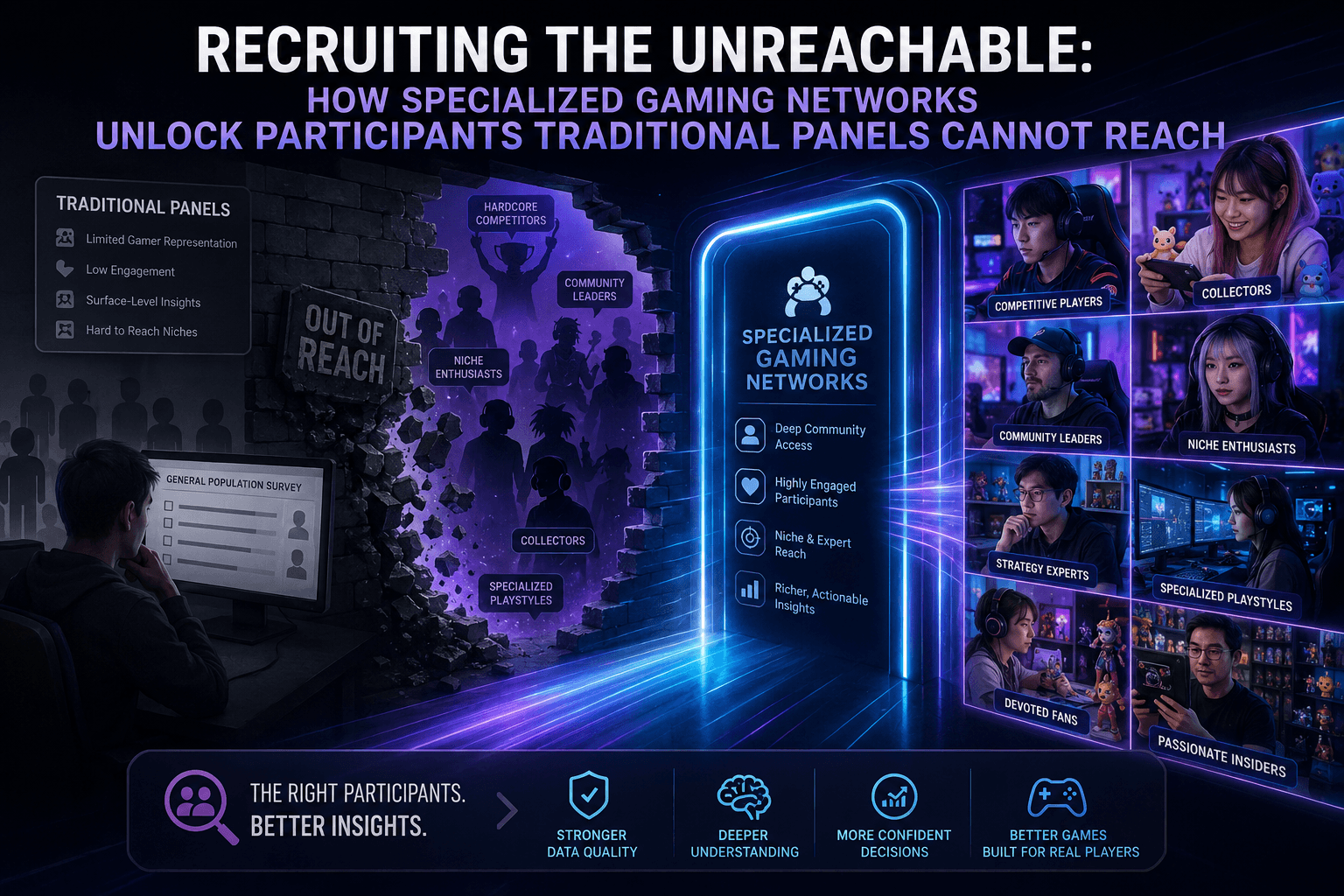
Traditional panel-based recruitment works well for broad consumer studies, but gaming audiences often behave very differently from general population respondents. Highly engaged players, competitive gamers, collectors, and niche community members frequently sit outside standard research ecosystems. Many of the most insightful participants are simply not present in conventional panels, making them difficult or sometimes impossible to recruit through traditional channels.
For gaming-focused research, access often determines insight quality.
The Limitation of Traditional Panels in Gaming Research
Panels are typically optimized for scale. They are designed to efficiently locate respondents who match demographic or behavioral criteria across common consumer categories. However, gaming audiences frequently organize themselves in ways that are not easily captured through panel profiling.
Highly engaged players often spend their time in:
Discord communities
Tournament circuits
Private online groups
Closed competitive ladders
Enthusiast forums
Local card shops and offline events
Community-run competitions
Genre-specific networks
These environments are often built on trust and shared interest. Participation is driven by passion rather than incentives alone. As a result, many players who are deeply invested in gaming do not register for research panels, and may not respond to generic recruitment outreach.
This creates a structural challenge for research teams attempting to understand advanced player behavior, niche genres, or competitive ecosystems.
Direct Access Through Gaming Community Presence
Our approach to recruitment is shaped by direct participation in the gaming community itself. Members of our team are active gamers with strong networks built through years of competitive play and community engagement. Our team includes both professional and semi-professional players who regularly compete in tournaments and maintain ongoing relationships with other highly engaged players.
Because of this, we are able to recruit participants through direct connections rather than relying solely on panel intermediaries.
This allows us to reach:
Professional gamers who make a living through competition
Semi-professional tournament participants
Highly engaged hobbyists with deep genre knowledge
Niche community members
Trading card players
Competitive ladder players
Long-time franchise fans
Casual players with authentic play patterns
Genre specialists across PC, console, and mobile
Players deeply involved in community discussion spaces
Importantly, this network is not limited to one genre or platform. Our connections extend across competitive gaming, card gaming communities, and highly specialized niche segments.
This breadth allows recruitment coverage ranging from professional-level competitors to everyday casual players, ensuring that insights reflect the full spectrum of player experiences.
Removing the “Middle Layer” Improves Recruitment Quality
Traditional recruitment approaches often rely on multiple layers between the research team and the respondent. Panels, recruiters, and third-party partners each play a role in sourcing participants, but each layer can also introduce friction.
For highly engaged gamers, credibility is often a deciding factor in whether they choose to participate in research. Many advanced players are cautious about requests that appear generic or disconnected from their experience. When outreach lacks context or understanding of the space, participation rates can decrease significantly.
Direct communication with known community members helps reduce these barriers. When participants understand that the research team is familiar with the games they play and the communities they are part of, trust can be established more quickly.
This often results in:
Higher response rates
Stronger engagement during fieldwork
More thoughtful feedback
Deeper articulation of advanced mechanics
Increased willingness to participate in complex study formats
Access to Competitive-Level Insight
One area where specialized recruitment is particularly valuable is in studies requiring feedback from highly experienced players.
Professional and competitive players are often able to provide insights that differ significantly from general audiences. Their familiarity with advanced mechanics, meta systems, balance considerations, and long-term progression structures allows them to identify issues and opportunities that may not be immediately visible through casual play alone.
Recruiting these players can be difficult through traditional panels, as many do not participate in survey platforms and may be hesitant to engage with unfamiliar research providers.
Through direct community connections, we have successfully recruited professional and high-level players who have contributed valuable perspectives across multiple projects. These participants have helped clients better understand:
Competitive balance considerations
Progression system friction points
Monetization perception among highly engaged users
Long-term retention drivers
Differences between casual and advanced player expectations
Community sentiment and emerging play patterns
Clients have consistently noted the value of these perspectives, particularly in projects where understanding advanced player behavior is critical.
Coverage Across Casual, Enthusiast, and Professional Segments
While competitive players represent one important segment, it is equally important that research reflects the diversity of the broader gaming audience.
Our network allows recruitment across the full spectrum of player engagement levels, including:
Casual players who engage with games socially or occasionally
Mid-core players with regular play habits
Highly engaged enthusiasts
Competitive players
Professional-level participants
This ensures that studies can accurately capture how perceptions and experiences differ across player types, allowing insights to be contextualized rather than generalized.
In practice, this often leads to stronger strategic recommendations, as differences between segments can be clearly identified and understood.
Enabling Research That Would Otherwise Be Difficult to Execute
Certain research designs require participants who are both highly engaged and willing to commit meaningful time and effort.
Examples include:
In-depth interviews with experienced players
Extended online diaries
Gameplay-based feedback sessions
Studies requiring familiarity with specific genres
Feedback on complex mechanics or systems
Research requiring understanding of competitive environments
Studies targeting players of niche or emerging genres
Recruiting participants capable of providing high-quality responses in these formats can be challenging without access to communities where such players are active.
By leveraging existing relationships within the gaming ecosystem, we are often able to support research designs that might otherwise be considered high-risk from a recruitment perspective.
Recruitment as a Strategic Advantage
Specialized recruitment in Japan's gamer space should not be viewed as a logistical detail, but rather as a strategic component of research design.
When the right participants are included, discussions become more productive, insights become more actionable, and findings more accurately reflect real player experiences.
As gaming audiences continue to diversify across platforms, genres, and engagement levels, the ability to access specific communities becomes increasingly important.
Direct community presence allows recruitment approaches that extend beyond traditional panels, enabling research among audiences that are often considered difficult to reach.
In gaming research, access is often the difference between directional feedback and genuinely meaningful insight.
Turning Access into Insight
In gaming research, the difference between surface-level feedback and truly actionable insight comes down to one thing: access to the right players. As the Japanese gaming landscape continues to evolve across platforms, genres, and engagement levels, traditional recruitment methods alone are no longer sufficient to capture the full picture.
At CarterJMRN, our strength lies in our ability to go beyond panels and connect directly with the communities that define gaming culture in Japan. Through our embedded presence within these networks, we are able to unlock participants that others simply cannot reach—ensuring that our clients receive insights grounded in real player experiences, not approximations.
This is what allows us to consistently deliver deeper, more credible, and more strategic outcomes for gaming-focused research.
If you are looking to better understand the Japanese gaming market and engage the players that truly matter, we would welcome the opportunity to collaborate.
Please feel free to reach out to Alejandro Lopez to discuss how we can support your next gaming research project in Japan.