Crossplay in Japan: Opportunity or Obstacle?
Player attitudes toward cross-platform gaming in Japan reveal both growth potential and cultural friction points.

Written by
Carter Gaming Lab
Articles
Aug 4, 2025
4 min read
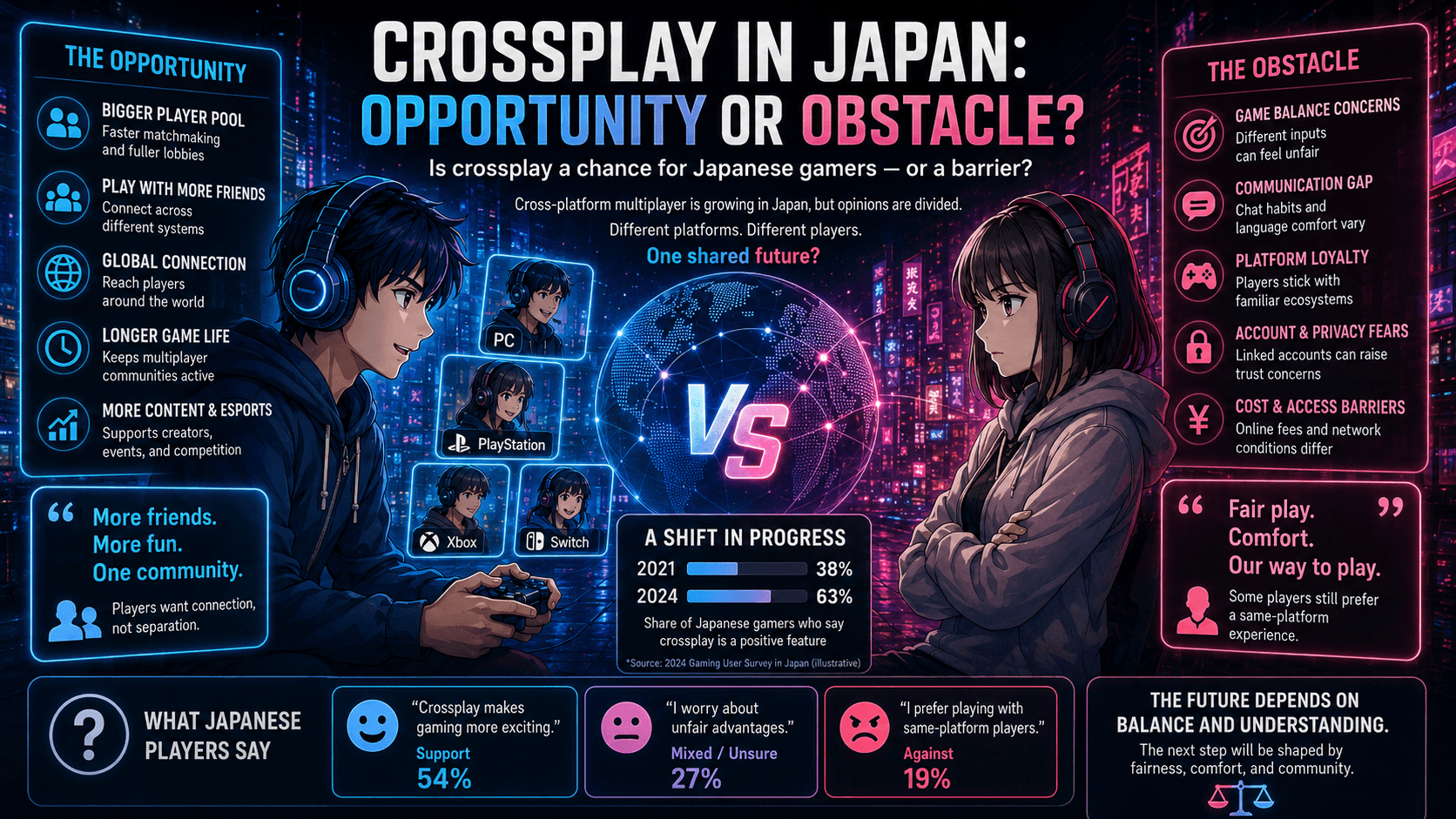
Cross-platform multiplayer, or crossplay, has become a major selling point for global titles, allowing players on different hardware to compete or cooperate in the same game environment. In Japan, adoption is on the rise, but not without resistance. While certain communities embrace the feature for expanding friend networks, others remain cautious due to gameplay balance, communication styles, and platform loyalty.
The Numbers: A Gradual Climb
Industry data from Famitsu shows that in early 2025, approximately 36 percent of Japanese online multiplayer gamers regularly use crossplay, up from 21 percent in 2021. By genre:
Battle Royale and FPS titles lead in crossplay adoption, with over 60 percent of active players enabling the feature
Co-op RPGs show moderate adoption at 38 percent
Fighting games and sports titles remain below 25 percent, with most players preferring same-platform matchmaking
Why Some Players Embrace Crossplay
Our analysis points to three main motivators behind positive reception:
Expanded Player Pools
Crossplay reduces matchmaking wait times, especially for niche genres or titles with smaller domestic player bases.Playing with Friends Across Platforms
Younger players, especially in high school and university, see crossplay as a way to maintain gaming connections despite owning different consoles.Access to International Competition
Competitive players value the challenge and prestige of facing opponents from around the world.
As one respondent in a Tokyo-based playtest told us, “If my friends are on PC and I’m on PlayStation, I do not want to lose that connection just because we bought different hardware.”
The Sources of Resistance
Despite the benefits, barriers to wider adoption remain:
Perceived Input Imbalance: Many console players believe that PC players have an advantage due to mouse-and-keyboard precision
Communication Preferences: Japanese players often prefer controlled, familiar social environments, and crossplay can introduce unfamiliar or unwanted communication styles
Platform Identity: Loyalty to specific hardware ecosystems is still strong, and some players view crossplay as diluting that identity
From my own experience in competitive gaming, I have seen crossplay boost community size but also spark disputes about fairness. Without careful balancing, it can split rather than unite a player base.
Genre-Specific Opportunities
Crossplay adoption is not uniform. Titles that have succeeded in Japan tend to:
Offer strong filtering and opt-in settings, allowing players to choose who they match with
Balance input methods by offering aim assist or other mechanics to level the playing field
Provide clear communication tools suited to Japanese preferences, such as quick-chat menus and limited voice channels
Across multiple interviews in different genres, many respondents have mentioned that crossplay is most appealing when they feel they have control over it. Players want to choose when and how to connect with different platforms, rather than having the feature automatically enabled.
Strategic Implications for Developers
For developers targeting Japan, crossplay is best approached as an optional enhancement rather than a mandatory feature. Success depends on:
Giving players full control over crossplay settings
Ensuring balance between control schemes
Providing culturally aligned communication tools
Marketing the feature as a way to strengthen existing friend networks rather than replacing platform communities
For more insights into designing cross-platform experiences that resonate with Japanese players, contact Carter Gaming Lab.